
 ‘Ballet on the Saddle and Stage: Cosmopolitan Transnational Performance at Astley’s Amphitheatre’
Newly published in Eighteenth-Century Studies, vol. 57, no. 4 (2024): 453-78
DOI: 10.1353/ecs.2024.a931689
OMG, this has been such a labour of love. This is the project that reduced me to a weepy mess in the kitchen when a colleague read the first complete draft, and emailed that she loved it.
Some academic articles are tossed off in a matter of weeks. Some people find the rigours of academic writing seemingly effortless while others like myself find it excruciating. The obvious question is why do it then? Why persevere?
It’s partly the challenge. Partly the thrill when the words form themselves to give the precision of meaning that academic writing demands. And partly, in this instance, because the events and incidents of John Astley’s career proved just too damn fascinating to leave untold.
The article now in Eighteenth-Century Studies actually began life waaaaaay back as an invited book chapter for a publication my colleagues Michael Burden and Jennifer Thorp were developing. Their edited collection eventually materialised in 2021 as With a Grace Not to Be Captured: Representing the Georgian Theatrical Dancer, 1760-1830 and won that year’s Claire Brook Award – kudos to all involved!
Unfortunately, things at my end didn’t quite go according to plan. Writing should have happened during what proved a horror year when two close family members died, capped off my mother’s cancer diagnosis after she’d been unwell for months. Plus, there was one other issue: Michael had commissioned me to write about John Astley’s dancing on horseback. Yet the deeper I dug, the clearer it became that there was a much larger, very unexpected and more complex relationship between Astley’s Circus and ballet to explore.
So I withdrew from the publication (a shout out here to Joe Lockwood who covered Astley’s instead). The 250th anniversary of Astley’s Circus came and went. My work on John Astley got picked up and put down repeatedly between other commitments, often with a lapse of months or years between, which makes getting started each time slow and agonising while everything reassembles in your memory again.
Along the way, there was also one fortituous development. Amid this protracted gestation, Canada’s Simon Fraser University (SFU) launched the Reconstructing Early Circus website. I’d already visited the British Library to photograph and examine the Theatre Cutting volumes for Astley’s, which remain a valuable resource despite the vagaries of the volumes’ assemblage. But SFU’s new database, with all the cuttings fully digitalised and text-searchable was a boon, making additional connections and insights possible to further flesh out the timeline of developments at Astley’s.
Thus did the research and the resultant essay finally reach completion – and to my huge relief Eighteenth-Century Studies accepted the article despite its length overrunning the journal’s word limit. Small and not-so-small mercies.
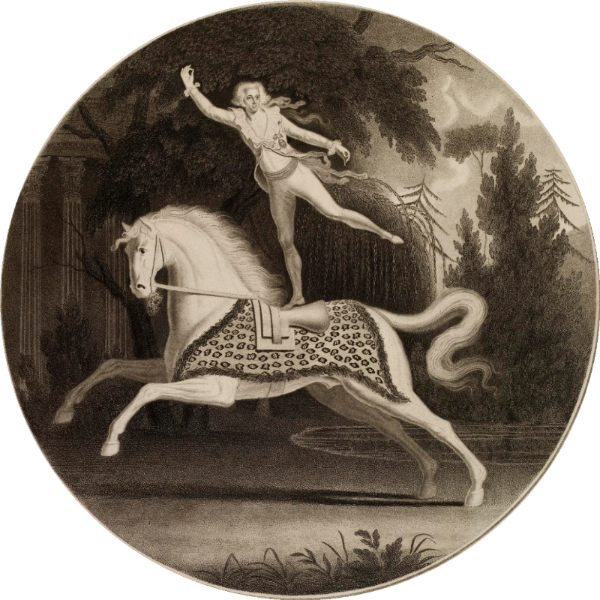 The article is in two parts, the first dealing with the phenomena that John Astley – boy wonder! – created in the 1780s by ‘dancing’ on horseback in his father’s circus (along with playing a violin, drinking wine and encircling himself with a hoop, all on horseback too). The second part looks at John’s subsequent stewardship of the circus during the 1790s and his particular interest in theatrical dance, which ultimately saw the Amphitheatre stage ballets of its own, many of them based on productions at the Paris Opera. That’s right: Astley’s even had its own version of La fille mal gardee!
Below is the article’s abstract. Head through Project Muse to Johns Hopkins to order, or use your institutional login to access. (General readers: sorry, like so much academic literature the article is behind a paywall.)
This article focuses on representations of ballet at Astley’s Amphitheatre to examine the venue’s negotiations of cultural difference and the politics of empire as a uniquely cross-Channel operation. Tracing the shifting role of ballet at Astley’s, from a source of inspiration for John Astley’s celebrated dancing-on-horseback routine to its inclusion as a stage-based, nominally “French” entertainment, the article proposes that theatrical dance provided an important counterpoint to the circus’s imperialist rhetoric and tendencies to jingoism. By facilitating the promotion of Astley’s as an enterprise mediating between French and British cultures, ballet enabled Astley’s to manifest a commitment to cosmopolitanism that shored up the circus’s appeal across the social classes.