
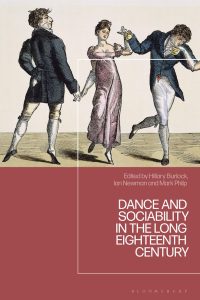
 Dance and Sociability in the Long Eighteenth Century
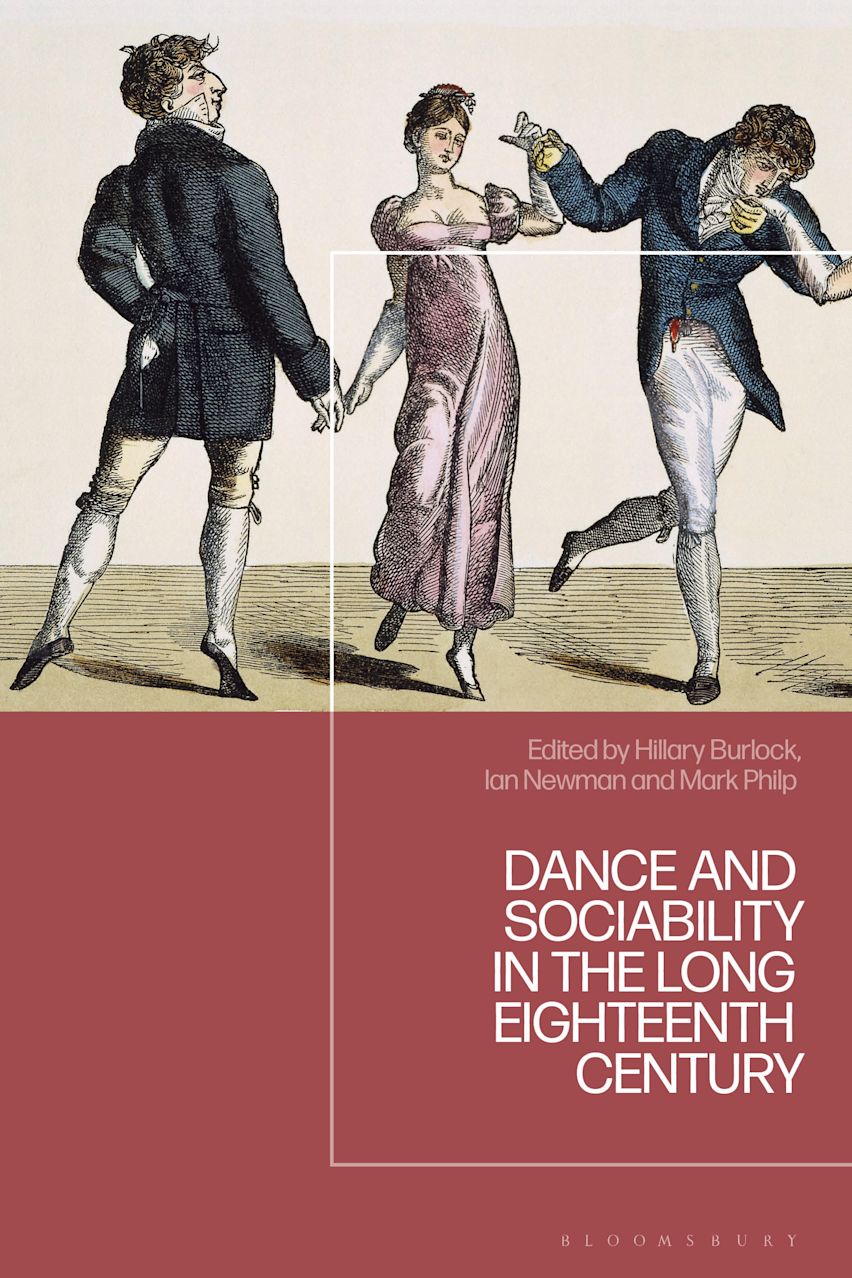
Edited by Hillary Burlock, Ian Newman and Mark Philp
Published 5 February 2026, hardback/online, 280 pages.
Bloomsbury Academic, 234 x 156 mm, 9781350498921.
Click here to order EBook and Hardback
‘This collection challenges the dominant understandings of 18th-century sociability by placing dance, and the training and movement of the body, at its core. Rather than thinking of dance and music as peripheral ornaments to the complex business of Enlightenment society, it highlights them as important vehicles for the development and dissemination of the ideas and practices that shaped people’s social, emotional and intellectual worlds.
‘Exploring the relationship between dance and sociability, and the development of both through the long 18th century, chapters in this collection span different practices in England, Scotland, colonial America, the West Indies, Germany, the Low Countries and Norway. Taking an interdisciplinary approach, they argue that dance, which was entangled with concerns about touch, dress and bodies, was integral to the ways in which ‘enlightened sociability’ was understood, performed and accepted.’
Within this text, my own essay examines the imperative to walk, dance and bow with the feet ‘turned out’ – that is, with the legs rotated outward from the hip so that feet and knees face sideways rather than forwards. This was a central tenet of aristocratic deportment from the late seventeenth century onwards, and implicity reflected the ability of elite families to invest in the formative physical training of their offspring. Typically associated with formal presentation dances like the minuet, and still a fundamental requirement for ballet today, turning out the feet twinned connotations of physical dominance and civility to become integral to eighteenth-century ideals of male beauty.
Building on Karen Harvey’s work on masculine embodiment and the male leg, the essay draws on dance manuals, works for the theatre, correspondence, and graphic satire to examine how the nuanced representation of men’s feet, either turned out, stiffly facing forwards or depicted naturalistically, animated an array of complex visual narratives about class, polite and impolite conduct, affectation and social mobility, and crudity and boorishness.
I extend my sincere thanks to Mark, Hillary and Ian for the invitation to contribute and for their elegant steering of this project to fruition. A special thanks to Mark for support that secured my release to complete the chapter.
Click here to order EBook and Hardback
CONTENTS
Dancing Bodies1. ‘Je ne sais quoi’: Grace, Ease, and Embodiment in Georgian Britain, Hillary Burlock (University of Liverpool, UK)2. ‘Open to the World’: Masculinity and the Turned-out Body in England, 1720-1830, Caitlyn Lehmann (University of Melbourne, Australia)3. ‘Hopping in London’: Genre and Representation of Regency Dance in Austen and Egan, Ian Newman, (Notre Dame University, USA)Learning to Dance4. Dance lessons: Making young people genteel in eighteenth-century Norway, Elizabeth Svarstad (Norwegian Academy of Music, Norway)5. Dance at Home in Georgian England, Katrina Faulds (University of Southampton, UK)6. William Bodley Francis: An English performer and dancing master in early AmericaLynn Matluck Brooks (Franklin and Marshall College, USA)Stage and Ballroom7. Sociability and hidden connections: The ballet stage and ballroom in the long eighteenth century, Ambre Emory-Maier and Valarie Williams (Kent State University and The Ohio State University, USA)8. ‘German’ vs. ‘Viennese’: Notes on the social and conceptual history of waltzing in the German-speaking world. Hanna Walsdorf (University of Basel, Switzerland)9. From the Louvre to the Waltz: Changing Relationships within the Couple Dance, Moira Goff (Independent scholar)10. Courting a dancing court in waiting: Winning hearts and minds in Brussels: Embodying a restoration monarchy (1815 – 1830), Cornelis Vanistendael (Independent Scholar)
Dance Spaces11. Women Waltzing at Almack’s: New Freedoms and Constraints, Peggy Murray (Independent Scholar, USA)12. Music and Dances in Edinburgh Polite Society through the Eyes of British and French Travelers, 1784-1804, Sabrina Julliet Garzon (University Sorbonne Paris Nord, France)13. La Tumba Francesa: The dance event and the social club, Catherine Turocy (The New York Baroque Dance Company, USA) and Marcea Daiter (Antioch University, USA)Conclusion
Leave a Reply